✨ Hello, dear visitor. Buy products at the best factory prices on our website ✨
✨ Hello, dear visitor. Buy products at the best factory prices on our website ✨

 Step 1
Select a product.
Step 1
Select a product.
 Step 2
Add to quote.
Step 2
Add to quote.
 Step 3
Fill the form.
Step 3
Fill the form.
 Step 4
Send a request.
Step 4
Send a request.
 Step 5
Answer within 24 hours.
Step 5
Answer within 24 hours.

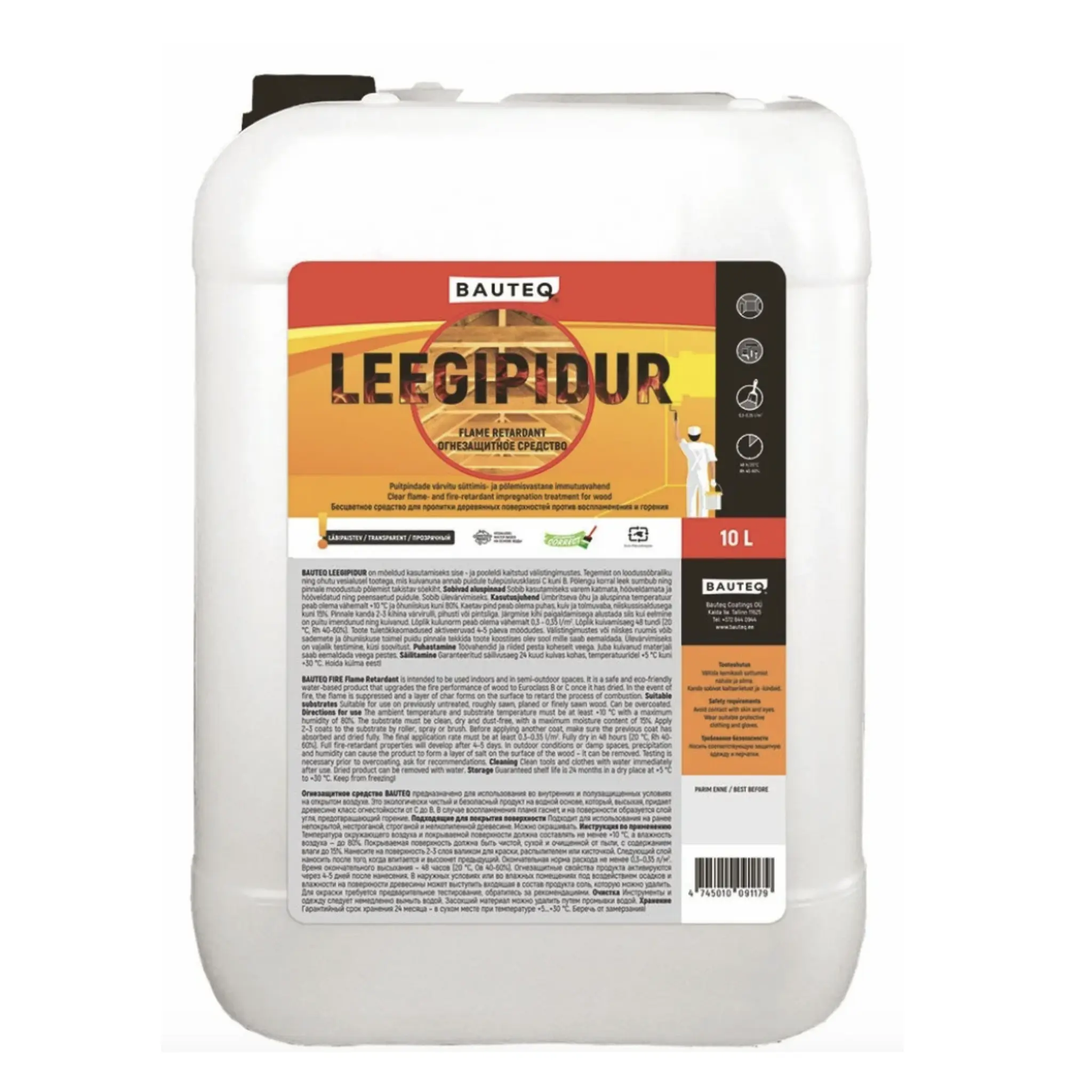
Bauteq flame proofer is a cost-effective, colorless impregnation agent for wood surfaces that prevents ignition and combustion. Suitable for use on untreated, planed and unplaned, as well as fine-sawn wood. FLAME PROOFER is designed for use indoors and in semi-protected outdoor areas. Once dry, it gives the wood fire resistance class B. In case of fire, the flame is extinguished and a protective char layer forms on the surface, preventing further burning.
AVAILABLE 2 SIZES:
10 L (weight: 11.8 kg ) – 36.4 €
25 L (weight: 29.5 kg) – 85.8 €
PRODUCT PROPERTIES
Water-based, neutral pH, colorless fire protection agent that penetrates well into the wood and, once dry, gives the wood fire resistance class up to B-s1, d0.
The active substance is potassium citrate, which is more ecological and health-safe compared to halogen-based fire retardants.
In the event of fire, wood surfaces treated with BAUTEQ Flame Proofer quickly form a protective char layer that prevents combustion and extinguishes the flame.
Application methods: industrial spraying, dipping, or application with a brush or roller.
| Technical data | Unit | Value |
|---|---|---|
| Consumption | L/m² | 0.35 |
| Relative density | kg/L | 1.15 |
| pH | – | 6.8–7.3 |
| Shelf life | – | 24 months in tightly closed original packaging (5–30 °C) |
| Packaging | – | 3 L, 10 L, 25 L |
AREAS OF USE
Suitable for use on planed, unplaned, and fine-sawn, untreated solid wood, primarily indoors.
For outdoor use, the treated wood must be protected with a suitable weather-resistant stain or paint.
Surfaces treated with the fire protection agent can be finished (after testing compatibility) with compatible decorative solvent-based stains, varnishes, or paints. In such cases, the final service life of the surface depends on the finishing material.
Not suitable for non-absorbent or glued surfaces such as veneer, plywood, or glued wood parts, as these cannot absorb sufficient fire retardant. For non-absorbent surfaces, fire-retardant lacquers and paints should be used.
SUBSTRATE REQUIREMENTS
The surface must be dry and free from substances that reduce adhesion. Remove dust, wax, dirt, and loose particles. Wood must not show signs of blue stain or mold. Wood must not have been previously treated with oils, waxes, or film-forming paints and varnishes. Generally, light wood species (birch, spruce, etc.) show minimal color change after treatment with fire protection agents. Wood species with a high content of extractives (oak, exotic woods, etc.) may show noticeable color changes. In rooms with high and variable humidity, treated surfaces may develop light mottling, become slippery, or form salt deposits from the product, which can be removed with a cloth.
APPLICATION RECOMMENDATIONS
Stir the product before and during use. The product is ready to use and does not require dilution. Reseal the package carefully after each use. Wood surfaces must be treated on all sides 2–3 times to achieve a total consumption of 0.35 L/m² (400 g/m²), which, according to MEKA SBI test report no. 6638-1/2022, gives fire reaction class B-s1, d0. The next coat can be applied after approx. 2 hours depending on drying conditions. Too long an interval (over 12 hours) before applying the next coat may reduce absorption. Fire protection properties are fully formed 4–5 days after treatment. Tools and clothing can be cleaned with water and soap. In case of mechanical damage to treated surfaces, the damaged areas must be re-treated with fire protection agent.
| Condition | Value |
|---|---|
| Fire protection agent temperature | +15…25 °C |
| Air temperature | +15…40 °C |
| Relative air humidity | 40–70 % |
| Wood moisture | 12–20 % |
| Application of next coat | 2 hours * |
| Solvent-based finishing coat interval | 15 hours |
*Data measured at 20 °C. Drying times and intervals between coats depend on temperature, relative humidity, ventilation, and the amount of material applied.
STORAGE
Protect from freezing. The optimal temperature for long-term storage is +10…25 °C.
The above data are based on laboratory studies and practical tests. The manufacturer is not liable for damages resulting from improper use of the product.
Check out other products in “Constructon Chemistry”
There are no reviews yet.
No manuals available for this product.
Smart wheel 1 generation bicycle modified electric vehicle power ...
Smart wheel 1 generation bicycle mo...
 Shop All
  Super Deals
  New
New